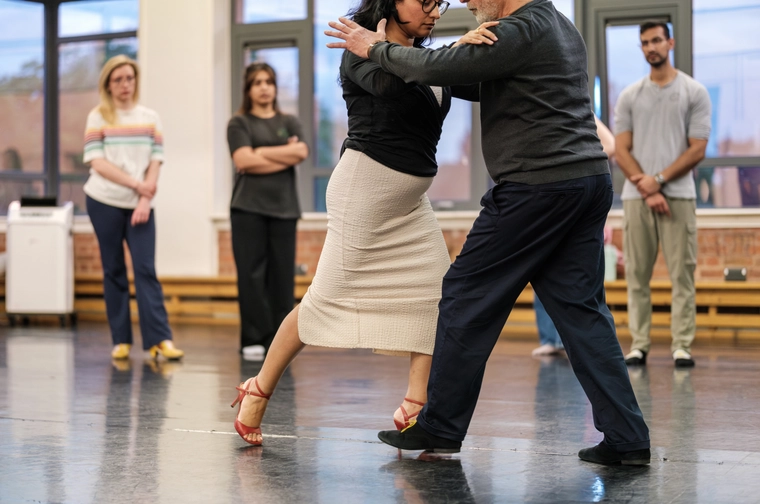
For anyone interested in Argentine tango, one question comes up again and again: is Buenos Aires really the best place in the world to learn it? The short answer is that it probably is, but not for the simplistic reason many tourists assume. It is not only the birthplace of tango or the city with the most classes. What makes Buenos Aires unique is that tango is still part of the city’s cultural bloodstream, from schools and stage shows to neighborhood milongas and major annual festivals.
That distinction matters. In many global cities, tango survives through dedicated communities, excellent instructors, and strong social scenes. But in Buenos Aires, tango exists on a broader ecosystem level. You are not just taking dance lessons; you are entering a place where tango has history, infrastructure, ritual, vocabulary, and daily life behind it.
So, is Buenos Aires the best place in the world to learn tango? For most students, especially beginners and intermediates who want immersion rather than just technique, the answer is yes. But the reasons are more nuanced than simple romantic slogans about dancing in the birthplace of the tango.
The strongest argument: immersion
The biggest advantage Buenos Aires has over every other tango destination is immersion. The city’s tourism authority describes Buenos Aires as the world capital of tango, with professional stage shows, musical performances, tango schools, tango cafés and hotels, and traditional milongas operating across the city. It also notes that many milongas host classes before the social dancing begins, which means a student can move directly from learning into practice.
That transition from class to real-world application is crucial. In many cities, students take one or two classes per week and maybe attend a monthly dance night. In Buenos Aires, a motivated learner can take a private lesson in the afternoon, a group class in the evening, and then go to a milonga at night to watch or dance. That rhythm compresses learning in a way few other places can match.
Immersion also changes your understanding of what tango is. In a studio outside Argentina, tango can feel like a technical dance discipline. In Buenos Aires, it becomes a social language with etiquette, customs, music traditions, and neighborhood personalities. You start to see the difference between performance tango, salon tango, practice spaces, and tourist-friendly experiences.
For serious learners, that depth is invaluable. It teaches not only steps, but context. And in a dance like tango, context is not an extra feature; it is part of the skill itself.
The historical and cultural case
Buenos Aires has a legitimate claim that no other city can fully replicate: tango developed here, alongside Montevideo, within the Río de la Plata region. UNESCO’s description of tango says the tradition was developed by the urban lower classes in Buenos Aires and Montevideo, and that it is still practiced in the traditional dance halls of both cities, spreading the spirit of its community across the globe.
That cultural legitimacy matters because tango is not just choreography. UNESCO and heritage-focused sources describe it as a living tradition shaped by migration, music, poetry, and social exchange. In other words, tango carries memory and identity, not merely technique. Learning it in Buenos Aires means learning in one of the places where those layers are still visible in everyday cultural life.
Buenos Aires also institutionalizes tango more visibly than most cities. The local tourism authority highlights the Buenos Aires International Tango Festival and World Cup every August as the world’s biggest tango festival, with free shows, classes, milongas, and the most important international dance contest for stage and salon dancers. That tells you something important: the city does not treat tango as a niche hobby, but as a major public cultural asset.
For students, this creates a powerful environment. You learn in a city that constantly reinforces the value of tango through festivals, venues, classes, and public recognition. That kind of reinforcement deepens motivation and gives the dance a meaning that can be harder to feel elsewhere.
Access to schools and teachers
Another reason Buenos Aires stands out is sheer density of instruction. Search even lightly and you find a wide range of tango schools, private teachers, practice spaces, and immersion programs aimed at every level. The city tourism site explicitly says there are several world-famous tango schools in the city, and commercial schools currently advertise private classes, group lessons, guided practice, and multilingual instruction for beginners through professionals.
That density gives students options, and options matter. A beginner can choose a friendly introductory school or a short tourist-focused package. An intermediate dancer can seek stronger technical instruction. An advanced dancer can work with coaches who teach performance details, musicality, or floorcraft at a high level. In a smaller tango city, you might find one excellent teacher. In Buenos Aires, you can compare styles and methods across many teachers.
Buenos Aires also attracts travelers who come specifically to study. Current tango travel and training programs promote the city as a place where students from around the world come to train with top instructors in tango’s birthplace. Whether those programs are commercial or educational, they reflect a broader truth: Buenos Aires remains a global magnet for tango learning.
That does not mean every teacher in Buenos Aires is automatically superior to every teacher abroad. There are brilliant tango teachers in Europe, North America, and Asia. But as a total environment—teacher quality, volume of options, and closeness to active tango culture—Buenos Aires is hard to surpass.
Milongas change everything
If there is one feature that gives Buenos Aires a decisive edge, it is the milonga ecosystem. Time Out’s recent guide describes the city’s milongas as the vibrant heart of tango, places where music, dance, and culture come together. The Buenos Aires tourism site makes a similar point by calling them traditional social gatherings that amateur dancers return to night after night in search of the perfect embrace.
This matters because tango is fundamentally a social dance. You can learn technique in any studio, but you truly understand tango when you see how people dance it socially, how they navigate a crowded floor, how invitations happen, how the music shapes the room, and how subtle the dance can be when it is not performed for applause.
In Buenos Aires, students can observe this world directly. Even if you are too inexperienced to dance right away, simply sitting in a good milonga teaches a lot. You notice posture, floorcraft, musical phrasing, codes of respect, and the difference between flashy movement and comfortable social dancing.
That exposure accelerates learning. It also protects students from a common problem outside Argentina: confusing stage tango with social tango. Buenos Aires makes the distinction much clearer because both forms are visible side by side.
Reasons the answer is not absolute
Even though Buenos Aires has the best overall claim, it is not automatically the best place for every person at every moment. Learning tango in Buenos Aires requires time, energy, and some tolerance for late-night culture. Milongas often run very late, and the city’s tango rhythm can be exhausting for travelers who are not used to intensive dance schedules.
The city can also overwhelm beginners. A large number of schools and venues sounds ideal, but it can create confusion if you do not know where to start. For some people, especially shy beginners, a smaller tango community in their home country may offer a gentler first step.
There is also the practical issue of consistency. A two-week tango trip to Buenos Aires can be transformative, but progress in tango depends on repetition over time. For many students, the best approach is to build foundations at home and then use Buenos Aires as an immersion phase rather than expecting one trip to replace steady long-term practice.
So the strongest claim is not that Buenos Aires is magically superior in every way. It is that Buenos Aires offers the richest learning environment if you are ready to engage with it properly.
Who benefits most
Buenos Aires is probably the best place in the world to learn tango for three types of people. First, it is ideal for motivated beginners who want immersion and are excited by culture, not just dance mechanics. Second, it is excellent for intermediate dancers who need more social floor experience and want to refine musicality and technique in a dense tango ecosystem. Third, it is deeply rewarding for advanced dancers who want direct contact with top teachers, festivals, and a city where tango still feels alive rather than reconstructed.
It may be less ideal for travelers who want only a one-off novelty experience. Buenos Aires is wonderful for a private lesson or beginner class, but its biggest strengths reveal themselves when you stay long enough to combine lessons, observation, and social dance exposure.
That is why many tango tours and training weeks market immersion rather than isolated classes. The city makes the most sense when you treat it as an environment, not just a backdrop.
Final answer
So, is Buenos Aires the best place in the world to learn tango? In the broadest and most meaningful sense, yes. It offers the strongest mix of historical authenticity, cultural context, teaching depth, festival prestige, and active milonga life of any city on earth.
Montevideo shares tango’s historical roots, and many other cities have outstanding tango communities. But if you ask where a student can most fully experience tango as a living culture rather than only a dance class, Buenos Aires remains the clearest answer.
What makes the city special is not simply that tango was born there. It is that tango is still practiced, taught, debated, celebrated, and lived there at every level, from beginner class to world championship. That is why for so many dancers, one trip to Buenos Aires becomes the moment tango starts to make real sense.