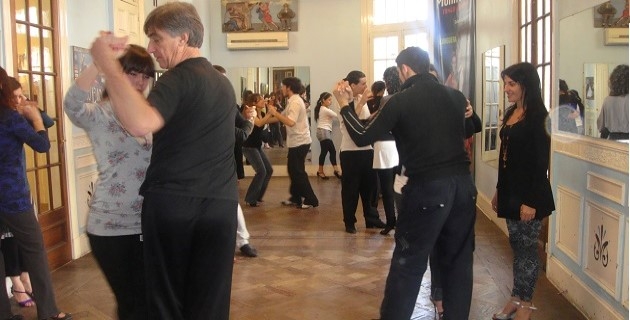
Buenos Aires remains the dream destination for people who want to learn Argentine tango properly. The city offers something that most places in the world cannot: a dense network of schools, private teachers, practicas, and milongas all operating within a culture where tango is still part of urban identity. But for foreign students, choosing the right school is not as simple as picking the most famous name. The best option depends on language support, teaching structure, neighborhood, class format, and how comfortable the school is with international students.
Some schools are excellent for serious long-term study. Others are better for beginners who want a welcoming environment and a gentle introduction. Some schools function as true training centers, while others are more social, using classes as a bridge into Buenos Aires nightlife and milonga culture. For foreign students, the ideal school is usually one that teaches well and also helps you navigate the local tango world.
This guide looks at the strongest tango schools and programs in Buenos Aires for international learners in 2026, focusing on what makes each one stand out and which kind of student it suits best.
What foreign students need most
International students usually care about a few practical things before anything else. They want to know whether classes are available in English, whether the school has a clear level system, whether private lessons are easy to arrange, and whether the environment is welcoming for complete beginners as well as travelers staying only a short time.
That is why the “best” school is not always the one with the most advanced dancers. A technically brilliant school can still be frustrating if it lacks language support or assumes everyone already understands tango etiquette. On the other hand, a slightly less formal school may be ideal for foreigners if it combines friendly teaching, bilingual communication, and easy access to social dancing.
Another key factor is integration. The strongest schools do more than teach steps. They help students understand the codes of the milonga, connect with the local tango scene, and move from classroom learning into actual dancing or observation. For foreigners, that bridge is often the difference between taking a few classes and truly experiencing tango in Buenos Aires.
DNI Tango
If one school appears repeatedly in recommendations for serious students, it is DNI Tango. Reviews and school information describe it as a structured tango school with multiple levels, world-class instructors, private classes, and a methodology that covers beginners through master-level dancers. Student reviews specifically praise its broad program, daily classes, and the fact that all group classes are taught in both English and Spanish, while private lessons can be arranged in several other languages.
For foreign students, that bilingual structure is a major advantage. It removes the fear that many visitors have when walking into a respected Buenos Aires school for the first time. You do not have to guess whether you will understand corrections, and you can follow the logic of the class rather than just copying movement.
DNI also stands out because it offers what reviewers describe as a strong private-study system. One Yelp review highlights a sequence of one-hour private classes followed by “private practicas,” where students continue working on the same concepts over subsequent days. That kind of system is especially useful for foreign students staying in Buenos Aires for one or two weeks and wanting visible progress in a short period.
This school is best for students who want a serious learning base. If you care about technique, method, and the possibility of combining group classes with private study, DNI is one of the strongest choices in the city.
Escuela Mundial de Tango
Another excellent option for foreign students is Escuela Mundial de Tango Gabriela Elías. Official and institutional descriptions say the school has more than 20 years of experience, offers around 90 classes per week with more than 40 teachers, and provides classes in tango, milonga, waltz, technique, and different styles. Importantly for international learners, Argentine government directory information lists language support in Spanish, English, French, and Italian.
That combination of scale and multilingual capacity makes the school especially attractive for foreigners who want choice. A large schedule means more flexibility if you are fitting tango around sightseeing, remote work, or Spanish classes. It also means you are more likely to find classes at the right level rather than squeezing into a group that is too basic or too advanced.
Recent class information and traveler reviews also reinforce the school’s accessibility. The official classes page mentions English-language availability, and Tripadvisor reviews note that non-Spanish-speaking students are accommodated and that beginners get meaningful practice time with knowledgeable instructors.
Escuela Mundial de Tango is best for foreign students who want variety, multiple teachers, and a school that feels large and active rather than boutique. It is especially appealing if you want to study frequently and explore several aspects of tango beyond the basic social dance frame.
La Viruta
For many foreigners, La Viruta is the most approachable doorway into Buenos Aires tango culture. It is not just a school but a social institution, well known for its classes and milonga environment. Recent descriptions emphasize that it offers tango classes and milonga experiences for all levels, while traveler-oriented reviews describe it as welcoming, unfussy, and strongly focused on learning, with a crowd that mixes tourists, expats, and locals.
That mix is exactly why La Viruta works so well for international students. It can feel less intimidating than a pure technical academy because the atmosphere is social and the ecosystem is obvious: lesson first, then practice, then the deeper milonga energy later in the night. For a foreign beginner, seeing that full arc in one place is extremely valuable.
The downside is that La Viruta is not always the best environment for students seeking refined, highly structured technical progression. Crowded classes and a nightlife-style atmosphere can be fun and energizing, but they are not the same as a carefully tiered school system. Still, for foreigners who want an authentic and friendly introduction, few places are as useful.
La Viruta is best for social learners, beginners, travelers who want to meet people, and anyone who wants to feel the living atmosphere of tango instead of only studying it in a formal studio.
Mente Argentina
For foreign students who want a more guided and internationalized entry point, Mente Argentina is one of the most practical options. Its tango program is explicitly designed for participants from all over the world and combines private lessons, group classes, live milonga experiences, bilingual teaching in Spanish or English, and local support through an on-site coordinator and Palermo-based office.
This format is especially helpful for students who are visiting Buenos Aires for the first time and want more than just classes. Mente Argentina wraps tango into a broader support structure that can include scheduling help, accommodation options, orientation, and ongoing assistance. That makes the experience feel less like buying isolated dance classes and more like joining an immersion program.
The program also offers clear study intensity options. Current descriptions mention a regular 4-to-16-week format with three private and three group lessons per week, plus a two-week intensive option with four private and four group lessons weekly. For foreigners trying to organize a short but serious tango stay, that clarity is a real strength.
Mente Argentina is best for international students who want structure, support, and a ready-made program rather than building their tango schedule from scratch.
Other useful options
Not every foreign student needs a large formal school. Some travelers do better with smaller private instruction in neighborhoods like Palermo. Adrian Luna’s 2026 private tango offering, for example, is aimed at individuals, couples, and small groups seeking one-on-one instruction tailored to skill level and goals.
This type of format can be excellent for foreign students who are shy, short on time, or focused on personalized progress. It lacks the built-in community of a major school, but it can be more efficient if your priority is direct technical correction and a flexible schedule.
There are also language-school and culture-school hybrids. Vamos Academy and Academia Buenos Aires both connect tango activity with broader international-student experiences, which can suit foreigners who want to combine Spanish study and cultural immersion rather than commit to tango alone. Vamos Academy specifically notes free weekly tango classes for its students as well as paid group and individual options, while Academia Buenos Aires presents tango classes and shows as part of its cultural activity offering.
Another niche example is Tango & Tango, referenced in a 2024 guide as a school specifically designed for foreigners visiting Buenos Aires, with private and group classes for tourists, flexible schedules, and multilingual teachers. Even though it is less internationally prominent than DNI or Escuela Mundial, that positioning highlights an important point: some schools deliberately optimize for international accessibility rather than prestige alone.
How to choose the right school
The best way to choose is to be honest about your goals. If you want rigorous technical study with clear levels and bilingual teaching, DNI Tango is one of the safest bets. If you want variety, high volume, and multilingual support in a large-format school, Escuela Mundial de Tango is particularly strong. If you want easy social entry and a fun, mixed crowd, La Viruta is hard to beat. If you want an all-in-one immersion structure, Mente Argentina is probably the most convenient option.
Length of stay matters too. A traveler in Buenos Aires for four days may get more from a guided program or a social school than from trying to decode a very advanced academy. Someone staying for a month can afford to build a deeper training routine with private lessons, group classes, and milongas.
Language confidence is another deciding factor. If you are not comfortable learning dance in Spanish, prioritize schools that explicitly mention English support or multilingual teaching. That alone can dramatically improve your experience as a foreign student.
What to expect as a foreign student
Most foreign students arrive in Buenos Aires imagining tango as dramatic and cinematic, but the reality of learning is more subtle. Expect a lot of work on walking, posture, embrace, rhythm, and connection before you get to more complex movement. The best schools make this process feel rewarding rather than slow.
You should also expect tango etiquette to be part of the learning curve. Even friendly schools introduce students to milonga codes, social dancing norms, and the distinction between performance tango and dance-floor tango. This cultural learning is part of why studying in Buenos Aires feels different from studying elsewhere.
Finally, expect progress to depend on repetition. A few classes can be memorable, but real improvement usually comes when you combine lessons, practice, and observation. The good news is that Buenos Aires gives foreign students many ways to do exactly that.
Best overall picks
For most foreign students, the strongest all-around choices are DNI Tango and Escuela Mundial de Tango because both combine serious instruction with language accessibility and flexible study formats. La Viruta is the best social gateway, while Mente Argentina is the best packaged immersion option for travelers who want hand-holding and structure.
The real advantage of Buenos Aires is that you do not have to choose only one approach. Many foreign students use a school like DNI or Escuela Mundial as a technical base, then visit La Viruta for social practice and add private lessons or an immersion coordinator if they want faster progress. That mix often produces the richest and most realistic tango experience in the city.